This is turning out to be a brain dump of a post. Nevertheless, she persisted…..
Has anyone come across iron-off carbon paper for tracing on darts, dots, triangles and other pattern markings on the wrong side of cut out pieces, i.e. the markings essential to putting together a garment?
I’d love to work with a tracing wheel and carbon paper where the markings disappear with pressing, or exposed to air when I’m done sewing — much like the disappearing marking pens which can be ironed out. The advantage is that there is minimal handling of fabric; after the cutting process, you just insert the carbon under the fabric, keeping the paper pattern in place, and run a tracing wheel on the paper to mark the detail on the wrong side of fabric; for example, a dart.
What prompted this request for the notions industry:
I am in the middle of sewing a small capsule with lightweight knit fabric; the marking pens and chalks I want to use for marking the dots, darts, etc. are dragging and pulling on the fine knit — yes, even the dull pink chalk.
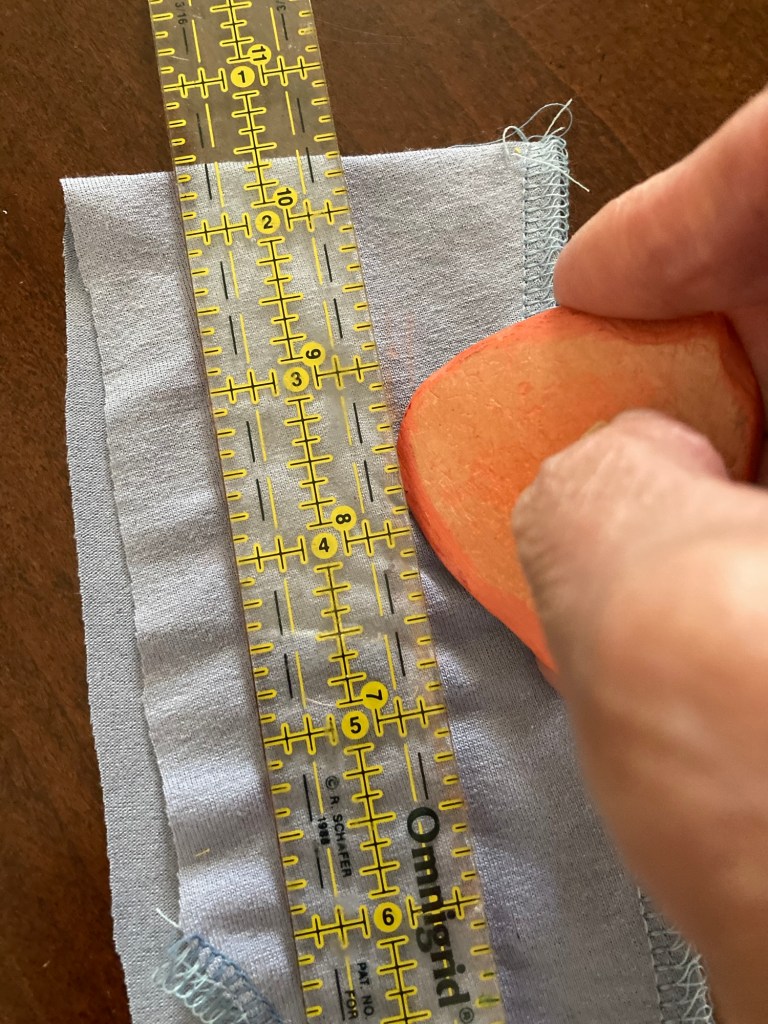
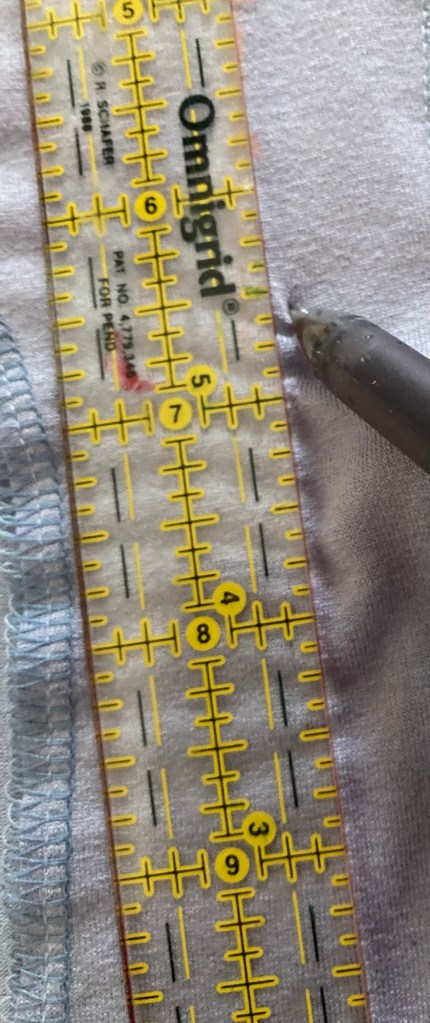
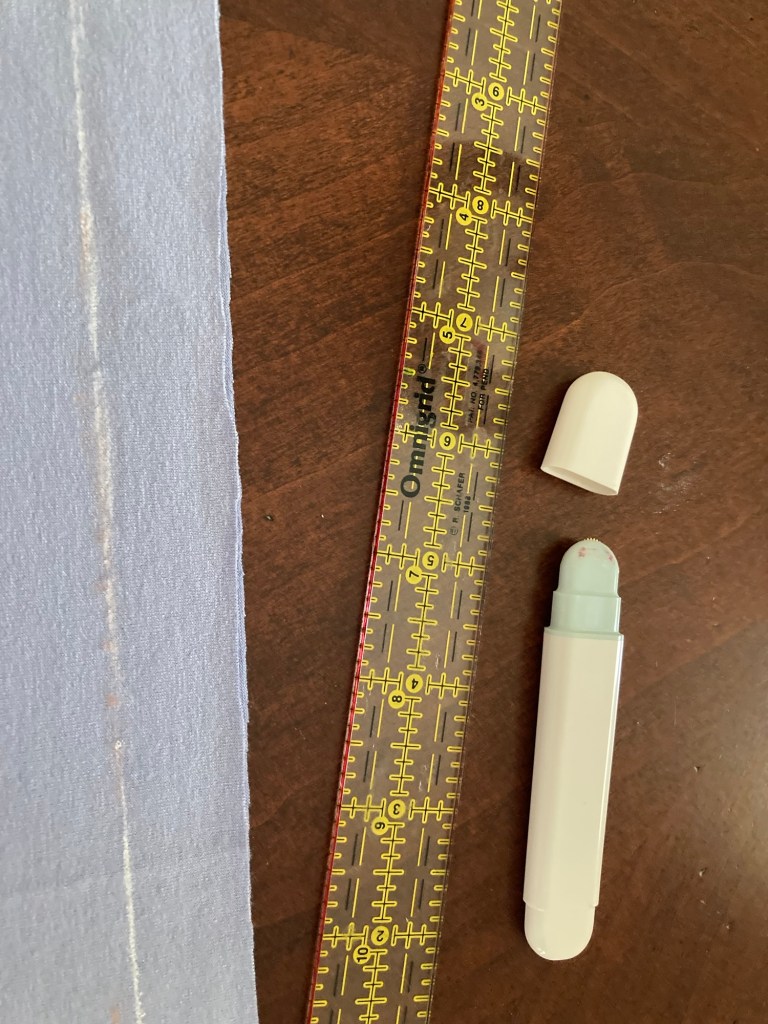
I ended up pinning and hand-basting the darts (I add bust darts on my lightweight knits but that’s another blog post). The tracing wheel and carbon would have worked well here, if only it wasn’t permanent. Therefore, I am requesting the sewing notions manufacturers to get your R&D department busy and please develop iron-off carbon paper.
I may be in the minority among my fashion sewing sisters, but I like using carbon and tracing wheel to mark details on the fabric pieces (wrong side, mind you) ready to be sewn — you know, the darts, dots, triangles, squares et al that are essential to sewing up the garment pieces correctly.
Before the haute couturiers clutch their pearls, I will say that there is something to be said for the old tracing wheel and carbon paper method. I like that it does not disappear by the time you get around to using those markings. On the flip side, they are permanent. I can see why it is upsetting for us fine-sewing practitioners.
Increasingly, though, it is irritating to me that an essential task in prepping the fabric pieces would take longer than necessary. I’m 76, getting more crotchety and time is not on my side. I want to quickly make a nice, well-fitting outfit and wear it. Wearing a well made piece, sewn by myself, is now the topmost goal in my sewing life, not necessarily extending the time I spend making it.
Dear readers, if there is such a thing as an erasable/washaway/iron-off carbon paper on the market, please point it out. And then, you can just ignore my words here. Thank you from the bottom of my heart. ❤️
Until next time…
Samina


Thoughts on pattern marking: I understand your dilemma but I have had a complete aversion to tracing wheels and carbon paper from the first time I was required to use it in 7th grade Home Economics so many moons ago! (I’m only 2 years behind you so I understand the crotchety attitude and ticking of the clock!). I have never seen a disappearing paper but WAWAK Sewing Supplies sells a “Fine Point Disappearing Marking Pen (item #CK10PU) that may be useful but I think you’d have to perforate the tissue marking first and then dot the pen through the perforations onto the fabric.
As for marking thin, fine fabrics I have used tailor thread tacks since that 7th grade aversion as my dear mother taught me. If, in this technologically advanced era, carbon marking became a disappearing act I would certainly be on board with it!
P.S.: I do have pearls but they remain in the box and have been replaced by readers on a chain! Besides, my loyalties remain with my German tailor and seamstress ancestors! 🙂
Cheers!
Charlene
LikeLiked by 1 person
I totally felt you looking over my shoulder while writing this post. I remember you being so averse to the carbon transferring the marks 🙂 . I agreed with you. Now, the tracing wheel/carbon is growing on me —- except for that issue with removal of the carbon lines. Thank you for reading and commenting, my dear friend!
LikeLike
I find the carbon paper at the thrift store occasionally
LikeLiked by 1 person
Thank you — I should make my way to a thrift store — amazing what one can find there. I’m looking for a carbon that specifically gets removed with ironing it out. I guess it hasn’t been developed yet.
LikeLike
Have you tried a sliver of soap, shaped like marking chalk?
LikeLiked by 1 person
Rachael, thank you for the suggestion. The knit I am working with gets dragged with even the softest marking tool. That is what prompted this post where the carbon and tracing wheel seemed to be the tool that would cause the least amount of fabric drag.
LikeLike
Did soap glide for you on the fabric that you were working on? Soap has definitely been the smoothest marker for me. The next most smooth marking after soap is washable crayola markers and are my go to as they’re so convenient and wash off well. If you use markers, test by ironing over and then washing as heat may potentially set the marks. And make sure to test on each new fabric.
Good luck!
LikeLike
I’ve used Saral for years with a tracing wheel without issue. But always excited to hear other ideas. Thanks Samina for your post. https://www.wawak.com/cutting-measuring/pattern-making-paper-supplies/pattern-paper/saral-wax-free-transfer-paper-12-x-12/#sku=msc41wh
LikeLiked by 1 person
Wax free? I’ve never used it. Will give it a try. Thank you, Janice!
LikeLike
Hi Samina! I also feel your pain; mostly I use a Chakoner wheel for my knits but it does tend to disappear with handling, especially on the lighter colors. I do like a clay tailor’s chalk as it does disappear with the iron, but it does drag on fine knits. Mostly I use a wash away marker, the thicker point as ironically it leaves a mark when lightly dragged across knits, or for the rare dart I sew in a fine knit I just clip the dart legs to mark them in the seam allowance, then put a pin in the point, and line it all up at the machine. Or, I sometimes use a piece of cotton basting thread to completely trace the lines, but that’s a bit time consuming. The Saral sounds like it might be the solution, I can’t wait to see the results if you try it!
LikeLiked by 1 person
You know exactly what I mean, right? I did the same thing with the darts in my knits. Pinned the lines, then basted together, following the pins. In my project, the seam allowance was kinda narrow, so I wasn’t sure about clipping into it. Will try Saral.
LikeLike