Ken Sakata, creative director at the Front Office brand (pictured), is not the designer of this particular menswear garment, but he details the designer’s practical thoughts and processes — in this case, Errolson Hugh the designer of the ACRONYM brand, a designer most homesewers probably never heard of but should emulate.
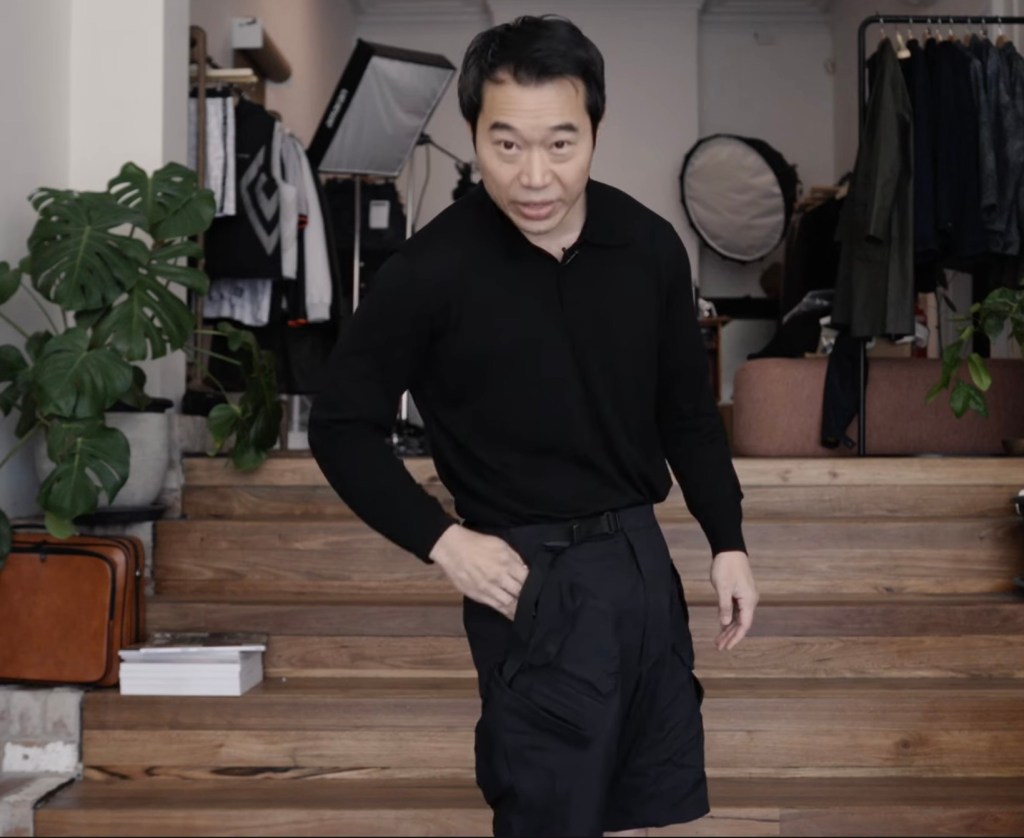

I am linking Dr. Ken Sakata’s (yes, he is also a medical doctor) Substack post as well as his YouTube video below featuring Errolson Hugh’s focus on pocket design — hope it will make you re-think pocket design (heck, any design) at the very granular level.
All of Ken’s posts that I have watched and read are unique and thoughtful in what actually goes into everyday, high end, utilitarian clothing.
On Substack:
On YouTube:
I highly recommend watching these short videos without missing Mr. Hugh’s surprise arm action to demonstrate a phone pocket in the sleeve. It’s magical!
In case you cannot access the videos, let me explain the thought behind Errolson Hugh’s pocket design: design should begin with the “first person” and how useful and comfortable it is for the user — the aforementioned “first person”. Worth noting is Errolson Hugh’s focus on placement and tilted orientation of useful pockets and why, the double pocket with pocket-bags on both front and back (much like a sherwani pocket I wrote about years ago), and a total of 14 pockets — 7 on each side — (!!) in just one pair of men’s shorts. There is no mention of the “second person” level so we’re moving on to the “third person” level: the looks. Visually it is a very handsome pair of shorts and Ken Sakata looks great. However, the high level of utility and comfort (first person) is the star of the show.
What about women’s wear?
Early and mid-twentieth century designers like Claire McCardell, and before her Coco Chanel did think about pockets — they combined a high level of utility (for their time) and highest style which is still relevant today; and as such they are my personal sartorial heroes.
To my knowledge, very few 21st Century designers put that much thought into women’s wear’s built-in “storage”, by which I mean pockets – if I missed someone, please comment below. The modern day House of Chanel still incorporates those iconic patch pockets with a braid edge, on their equally iconic jackets — are they “first-person” aligned though? Very little. Keys, phones, a lipstick, handkerchief/wipes and cash/credit card — a pocket for each with the right orientation is not much to ask.
From now on, I will intentionally think of the “first person” (me) before sewing in and maybe re-orienting a pocket.
Still pushing myself to sew more……
Samina
 Sew Everything Blog
Innovative thinking, to consider gravity when deciding how to orient pockets on clothing. I find when I have lots of pockets in my clothing (which I have experimented with) I can’t remember what is in which pocket and have to search multiple pockets to find what I want. I don’t care for the multiple pockets in the hip area, they make a person look like they are waddling, like a baby with a full diaper.
LikeLike
Heehee. Great comment. It’s conjuring up a cartoon in my mind!! I, too, wondered about the weight of stashed items pulling down on the silhouette, even with the reorientation of the pocket. I would assume, though, that most of us may not use all the pockets at the same time. Hmmm.
LikeLike