
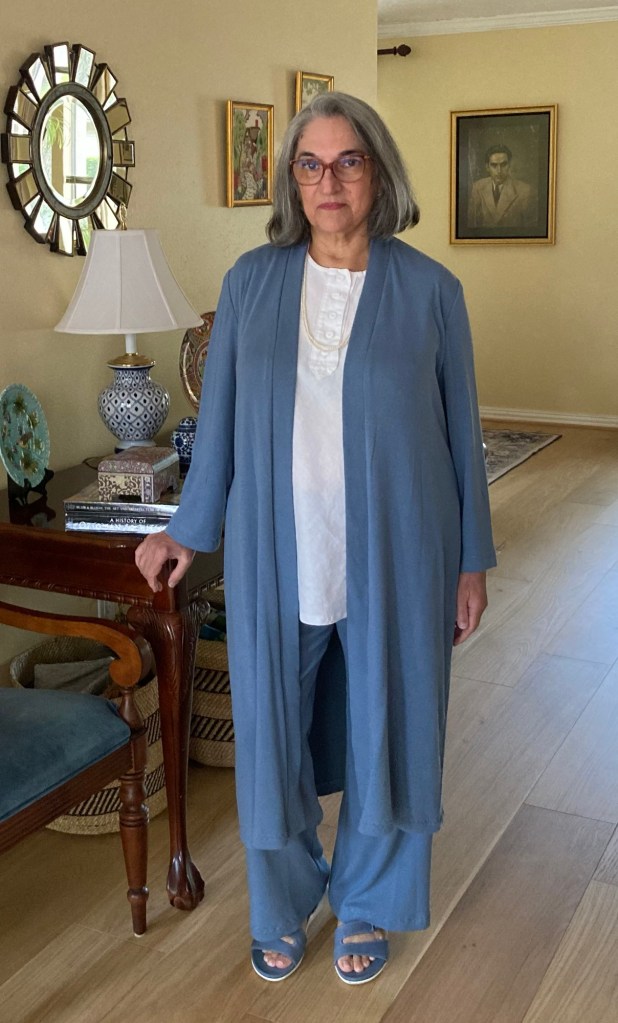
… and no, they are not pajamas. There’s nothing a pair of black, low-heeled pumps and a cross body bag won’t fix — instead of the sorry sandals I have on. Probably a different blouse, too. The outfit looks way better when I am walking around with the long cardigan swishing about. Read on and discover a secret about the pants.
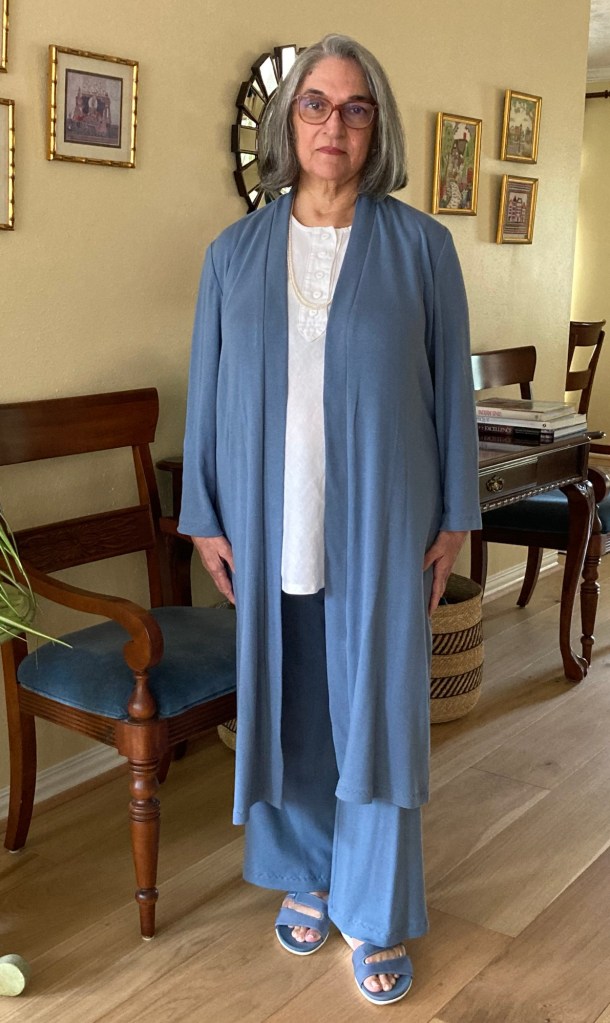
I managed to complete a sweater knit ensemble just as the warm weather took hold. Oh well; it can hang out in the closet until the onset of winter. There is no autumn in these parts.
The Sweater Knit Fabric
Never having made anything in a sweater knit, I had to look up some info on sewing. The fabric is from Sew Much Fabric in a sky blue (or sea blue or denim blue?) shade; it may be sold out, but feel free to visit the website. This sweater-knit cotton/Lycra is substantially stretchy with good spring-back qualities. It has a very fine ribbed look.
It isn’t what immediately comes to mind when you think “SWEATER KNIT” — a lofty, machine-knit formation. No, this is a light weight, albeit spongy sweater knit. It is not the interlock knit we use for t-shirts and such. The stitch formation is still “sweater”.
Cutting
For cutting out we need to do the usual: locate the straight grain, which is easy in this because of the thin but obvious ribbed look.
While laying it out, pat down the folds to flatten the yardage on the cutting mat, instead of pulling and pushing it around. I stayed away from a rotary-cutter since it tended to pull and misalign the fabric edge. For this, it was scissors only.
Stabilizing
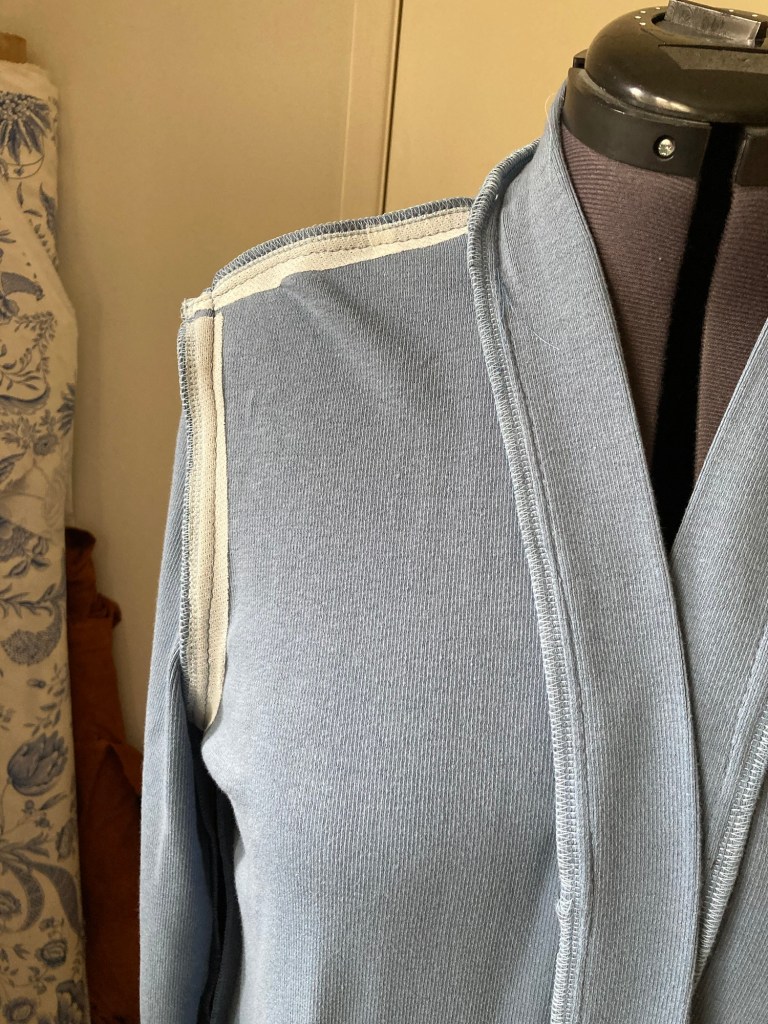
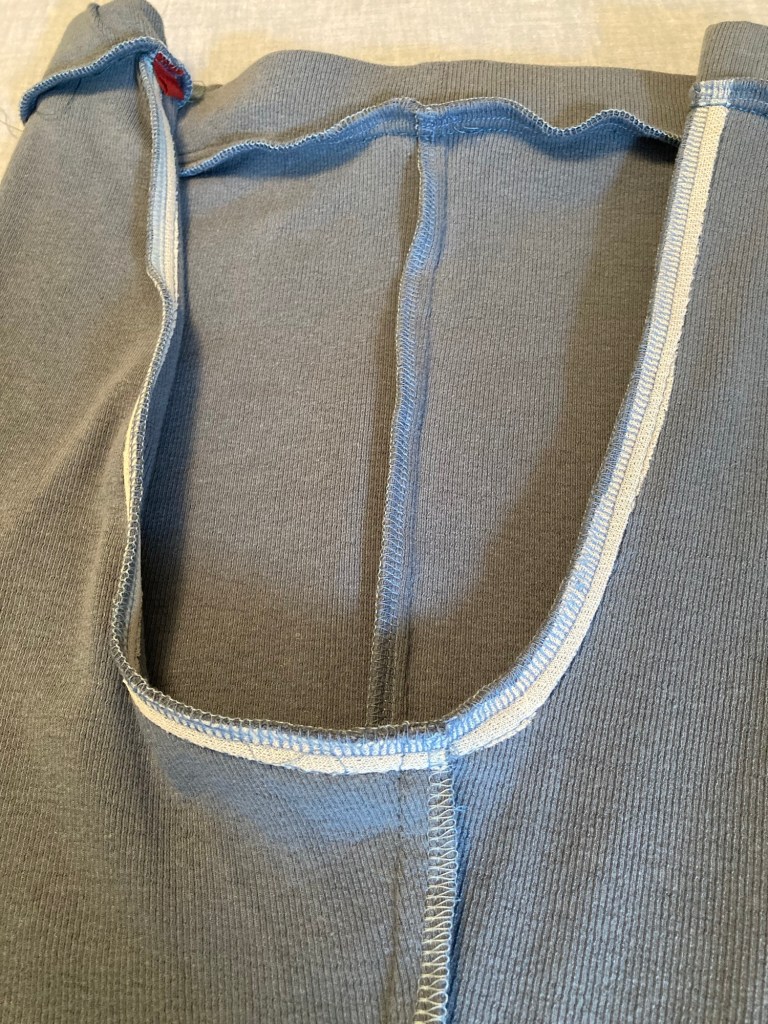
The fabric is inherently less stable, being a knit and all. So, I stabilized the back neck, the V of the front neck, shoulder seams, armhole seams and the pants’ crotch seam, using bias knit fusible strips. Did I overdo the stabilizing? No.
Sewing, Seam Finishing, Hemming
Use a jersey needle and a narrow zig-zag to stitch; I highly recommend a walking foot; if you do not have it, borrow from a friend who owns one —- after all, what are sewing friends for? Although, the walking foot has to fit your brand of sewing machine.
Fine gauge as it is, this sweater knit still has a spongy texture, so expect bulkier seams (bulkier than your regular interlock knit or a thin t-shirt knit). That means, select patterns with as few crossed seams as possible. It is still beautifully manageable. In my ensemble I serged all seams together instead of pressing them open.
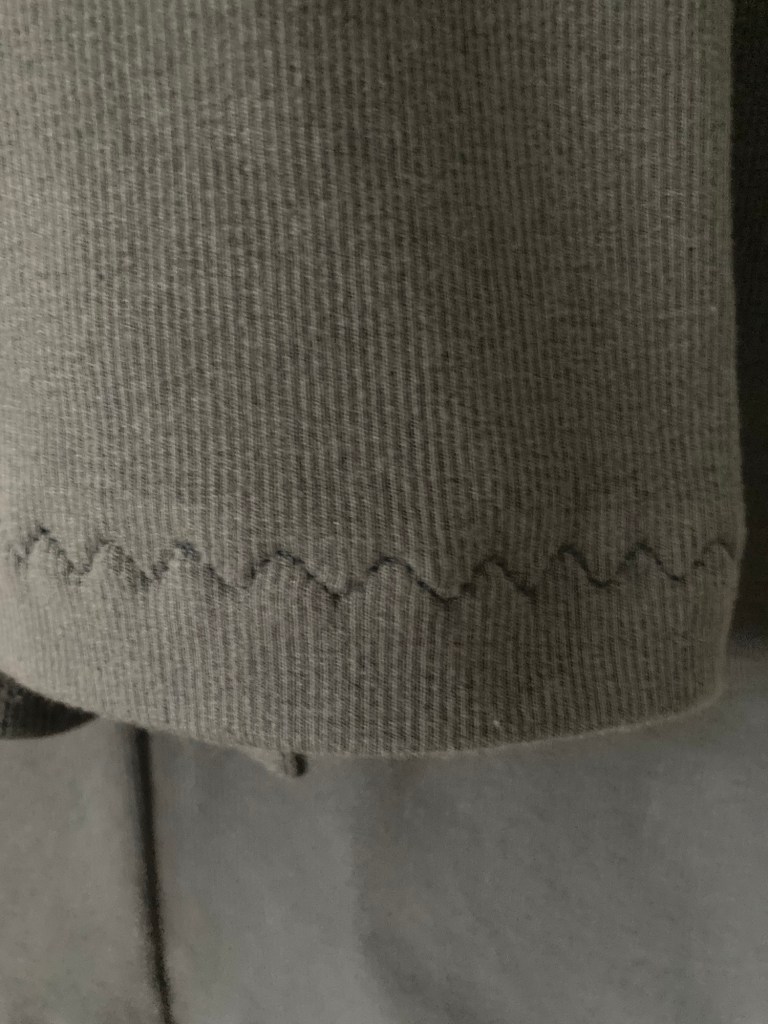
I do not have cover stitch capabilities but I always love the delightful triple zig-zag on my regular machine to finish the hems.
I used a light weight sew-in knit interfacing on just one vertical half of the front band; i.e. when you fold the band vertically, just one long side of it got interfaced. This prevented it from getting over-bulky but still had enough body to sew in buttonholes. Notice that I decided to forego buttonholes for now until I find just the right buttons — nothing wrong with wearing it buttonless. Or pocketless.
Secret
What is the secret behind those beautiful pants? I am wearing a full length pant-slip underneath; it somehow seems to help the drape of the pants, and is a totally separate piece. Mine is made in black Bemberg rayon so I can wear it under other pants in lightweight fabrics. I definitely plan on sewing another one in a tan or beige.
Next time, I should try a sweater knit with a slightly higher loft. Anyone who has sewn with a sweater knit, leave a comment. We could all use your input. Well, I am in love with this cozy, easy ensemble. Just don’t call it pajamas.
Thanks for reading! Until the next post,
Samina
 Sew Everything Blog
Samina, your creations are always exquisite! I have used sweater knit for several tops, from sweater-like turtlenecks to everyday tee-styles. I usually do them all on a serger with coverstitched hems. That’s a lovely fabric, and a rare find – cotton knits seem to be very scarce and expensive now. How I would love to have cotton interlock or sweater knit available at JoAnn’s as they were too many years ago. Living in the south, synthetic knits are oppressively hot most of the year. I will have to check out your fabric source. Thanks for sharing your latest make!
LikeLiked by 1 person
Pat, thank you for reading, and sharing your experience with sweater knits; next time I will definitely try using a serger only. Do you use a 4-thread stitch? You are correct in that cotton knits are hard to find these days.
LikeLike
Love your use of the triple zigzag on the hems. It adds a special decorative touch. The ensemble is lovely. I may have to try a pant-slip. Do the have an elastic waist or is a zipper used?
LikeLike
Thank you, Lenora! The waist of the pant slip has a 1/2” elastic. It’s a not-too-loose pull-up pant and very comfortable.
LikeLike
Wonderful ensemble, Samina! Thank you for sharing details of what/how you interfaced and stabilized — very helpful info!
Re. your custom pant slip: I have been thinking that I need to make some custom slips and camis for specific garments, as I perspire @ underarms, and do not want to have to wash or dry clean a silk garment after just one wear (hard on the garment). And, as you mentioned, undergarments do smooth and “lubricate” surfaces, so the garment flows over one’s figure nicely!
LikeLike
Thank you, Joan! Even though I live in southern climes and used to think more than one layer of fabric in the summer is too much, I have now changed my mind. Even in hot weather, camis and pant slips in smooth breathable fabrics feel quite cool. Your use of the word “lubricate” is so apt!!
LikeLike
Thanks Samina for the inspiration! I, too, enjoy pant ‘slips’. I’ve used china silk and lightweight linen and cut them on the bias so there is some ease of movement. They work well under my wool pants which I no longer need to line. I usually use a 5 thread serger stitch for construction adding stabilizer where needed. I like the word ‘lubricate’…thanks Joan.
LikeLiked by 1 person
Love this Samina! The color is beautiful on you!
LikeLiked by 1 person