
Or, gota-patti? Let me explain. In a nutshell, gota is a surface embellishment, indigenous to the Pakistan and Indian subcontinent. It is very, very old and traditional.

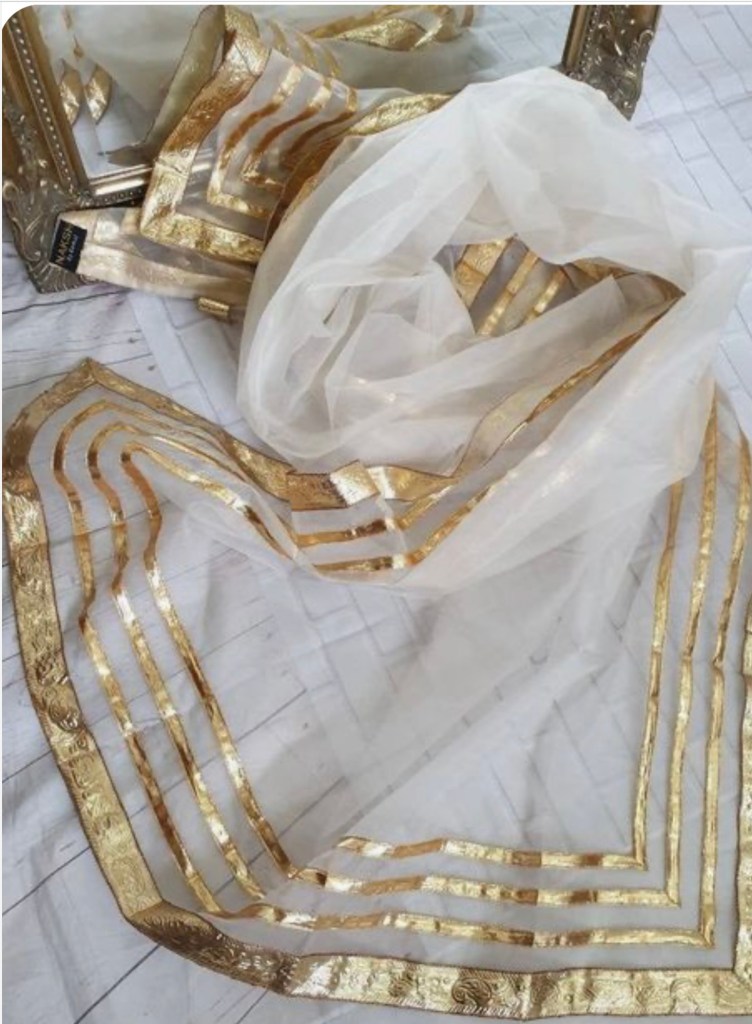
At the granular level, “gota” is just metal ribbon, beaten down to it’s thinnest and softest form, (or as one source relayed, it is molten metal applied to a soft core of flat thread?) and interwoven with cotton thread to further it’s malleability. This makes it easy to sew onto textile surfaces abundantly, and the ability to twist and shape the ribbon into curves, angles, and myriad formations without adding a lot of bulk and stiffness. Whereas, the original centuries old gota was real gold or silver (available for just the rich and royal), in modern times, the “metal” part is synthetic — maybe soft polyester. I’m thrilled that gota got democtratized.
Gota in ribbon form is manufactured in varying widths and shapes, and several metallic shades. It can be 2” or more in width or as narrow as 1/4” or less (!!).
The metallic tone determines the cotton thread incorporated in the ribbon. Silver shades of gota are interwoven with white or off white thread; and, gold shades of gota incorporates yellow or orange thread.
Then, variations in texture include crinkled, crushed or smooth.
The malleability of gota is kind of essential for twisting and turning it into other shapes. Techniques used are universal — such as the folded ribbon braid, folded flowers, leaves, crinkled into a round yo-yo shape and such. A lot of these gota shapes are now manufactured in a certain shape, or come pre-folded as a braid to make it easier for the user to embellish.
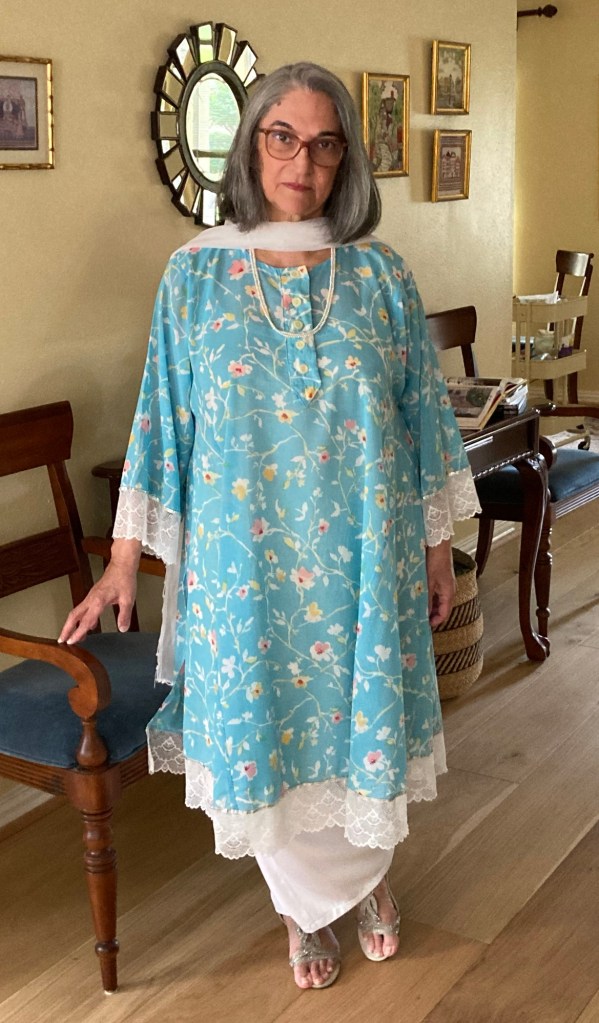
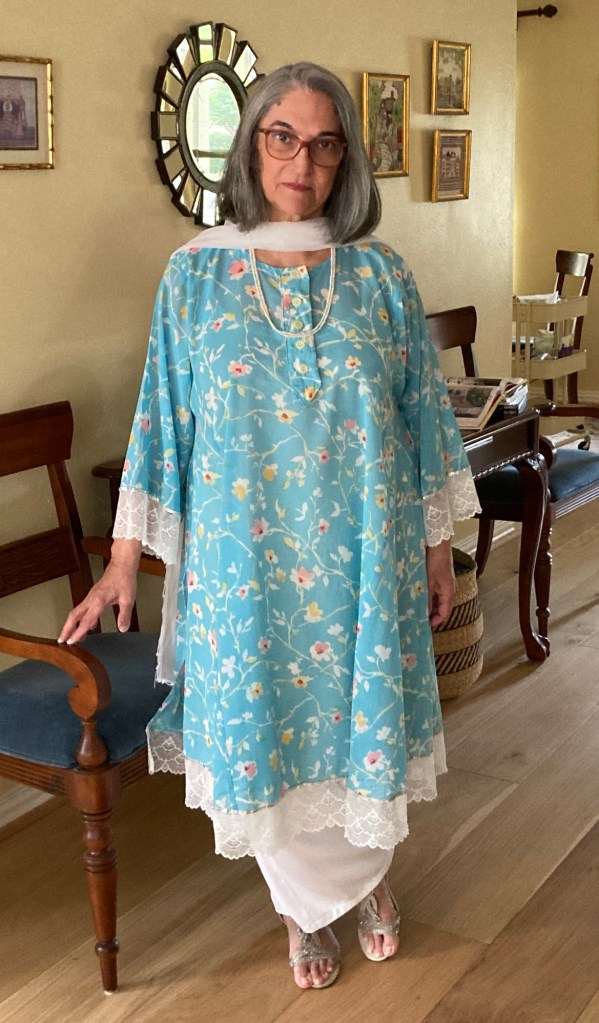
I recently took it upon myself to use narrow crinkled gota in a minimal linear application — it looks just like 1/8 inch ribbon sewn on straight across, but the softness of gota versus regular thin ribbon is hard to show visually. You just have to feel it. See photos of me in the blue kurta.
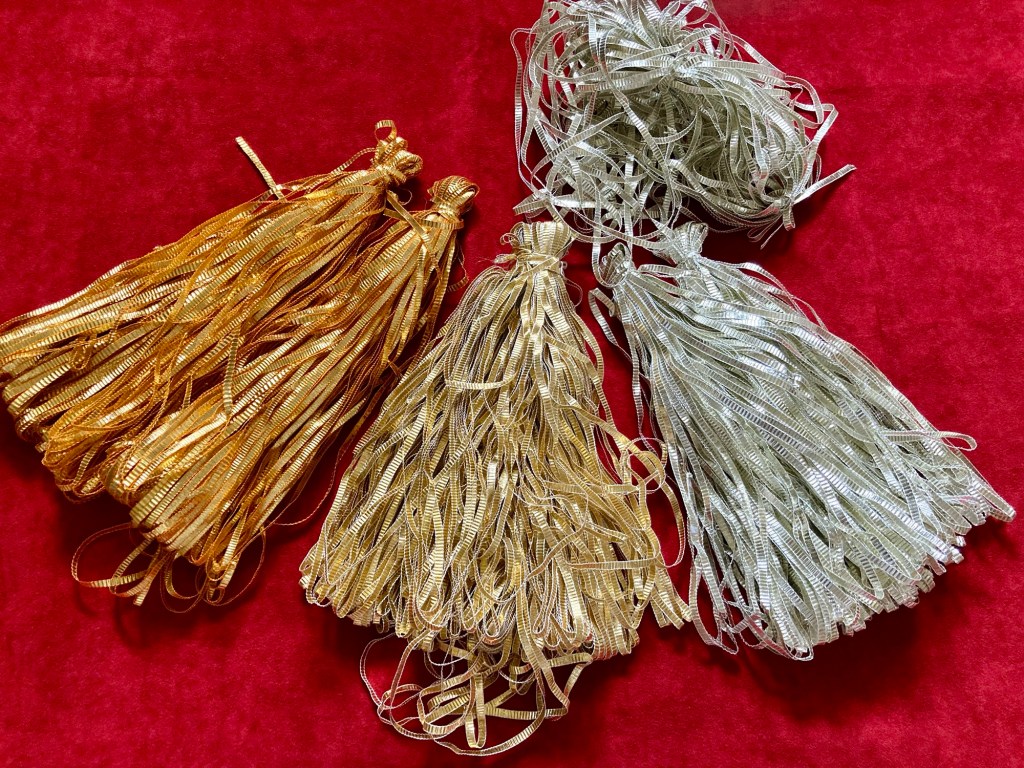
The hanks of narrow gota was ordered from Etsy for a very reasonable cost, and shipped all the way from India; it took 15 to 20 days to arrive, though.
Why do I prefer gota application by hand? It has a softness, which is somewhat compromised when you attach it by machine. I’ve seen YouTube videos where the narrow-ribbon-gota is applied with the bobbin-embroidery method — not quite the same result, in my opinion. A machine seam running through the ribbon-like gota adds too much thread. Application by hand involves a herringbone action, where the criss cross is visible on the wrong side and the straight stitches on two edges on the right side. It’s a slow process but so therapeutic. Or use some formation of the zig-zag on the narrower widths where the thread barely shows if it turns up on the right side. The wider widths can only be attached with a running stitch or back stitch on both edges — separately.
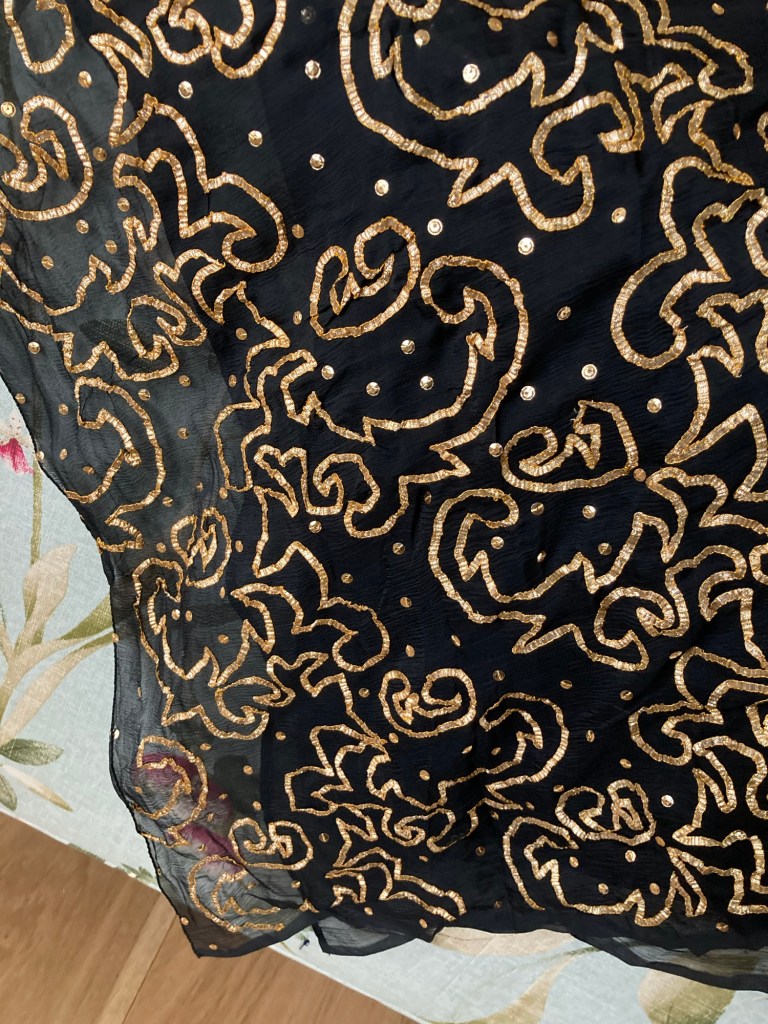
Also pictured below, is my sari — it is 50 years old and worn once or twice. Gold gota application on black chiffon is the epitome of high sartorial drama. Just wait — one of these days I will post up a photo of me wearing it.
For more eye-candy, check out my Pinterest board titled “GOTA”. Plus, click on the link below for an article published by Vogue India. It’s in English but there may be some terms which don’t make sense to you; in that case, just ask in the comment section. Enjoy!
Like it? Then go for the gota.
Samina
 Sew Everything Blog